
Green Paper on Bio Waste Management in the EU
” A Comprihensive Analysis “
Main Thematic Sections of the Green Paper on Bio-Waste Management
- Introduction and Objectives,
- Definition and Scope of Bio-Waste.
- Current Management Techniques,
- Current Management Practices across, EU Member States,
- EU Legal Framework,
- Environmental Impacts,
- Economic Considerations,
- Social and Health Impacts,
- Discussion Points and Policy Options,
- Consultation Process.
- The Greek Context and Policy Gaps,
- What Happens if Municipalities Ignore Bio-Waste Rules?
- Financial Support Details for Bio-Waste Projects.
What is Bio-Waste and why it matters
Management options (landfilling, composition, digestion, etc.)
Legal context and proposed policy improvements
Recommendations and future directions
Chapter 1: Overview and Policy Context
The Green Paper on the management of bio-waste in the European Union (COM (2008) 811 final) is structured around several key thematic sections. Here’s an outline of the main sections:
1. Introduction and Objectives
- Definition of the EU’s strategic goal to become a resource-efficient “Recycling Society”
- Introduction to bio-waste as a significant waste stream requiring attention
- Purpose of the Green Paper: to explore options for bio-waste management and invite stakeholder input
2. Definition and Scope of Bio-Waste
- Specific definition of what constitutes bio-waste (and what is excluded)
- Quantification of bio-waste generation in the EU (76.5-102 Mt from MSW, 37 Mt from food/drink industry)
- Characteristics of different bio-waste streams (green waste vs. kitchen waste)
3. Current Management Techniques
Overview of available management options:
- Separate collection systems
- Landfilling
- Incineration
- Biological treatment (composting and anaerobic digestion)
- Mechanical-Biological Treatment (MBT)
4. Current Management Practices Across EU Member States
- Three main approaches to bio-waste management in different Member States
- Statistics on current practices (landfilling, incineration, recycling rates)
- Separate collection implementation in various countries
- Compost production and usage patterns
5. EU Legal Framework
- Waste management legislation affecting bio-waste
- Regulations governing the use of compost and digestate
- Energy recovery policies and renewable energy targets
6. Environmental Impacts
Environmental effects of different management options:
- Landfilling (methane emissions, leachate, land use)
- Incineration (energy efficiency, emissions)
- Composting and anaerobic digestion (soil benefits, carbon sequestration)
- Comparison of options using Life Cycle Assessment
7. Economic Considerations
- Cost comparisons of different management options
- Investment costs for treatment facilities
- Market conditions for compost and biogas
- Challenges of separate collection systems
8. Social and Health Impacts
- Employment effects of bio-waste management options
- Health impacts on populations near waste facilities
9. Discussion Points and Policy Options
- Waste prevention strategies
- Further restrictions on landfilling
- Treatment options for diverted bio-waste
- Improving energy recovery
- Increasing recycling through targets or obligations
- Quality standards for compost and digestate
- Operational standards for treatment facilities
- Future technologies and research directions
10. Consultation Process
- Invitation for stakeholder contributions
- Timeline for analysis and potential policy proposals
Chapter 2: Greek Context and Implementation Challenges
1. The Greek Context and Policy Gaps
- Despite favorable conditions (agricultural output, green biomass, mild climate), Greece lacks a comprehensive strategy for bio-waste and plant residues.
- Municipalities often do not take responsibility for collection.
- There are so specialized (brown) bins or designated collection points.
- Illegal dumping in rivers and financial burden.
Best practices from Other Countries:
- Denmark: Produces energy and district heating from green waste and plans to build the world’s first “energy island” by 2036.
- Ireland: Powering thousands of homes through bio-waste treatment,
- Scotland: Aiming for “zero waste” through full energy recovery.
Proposed National Actions:
- Municipal – scale composting units.
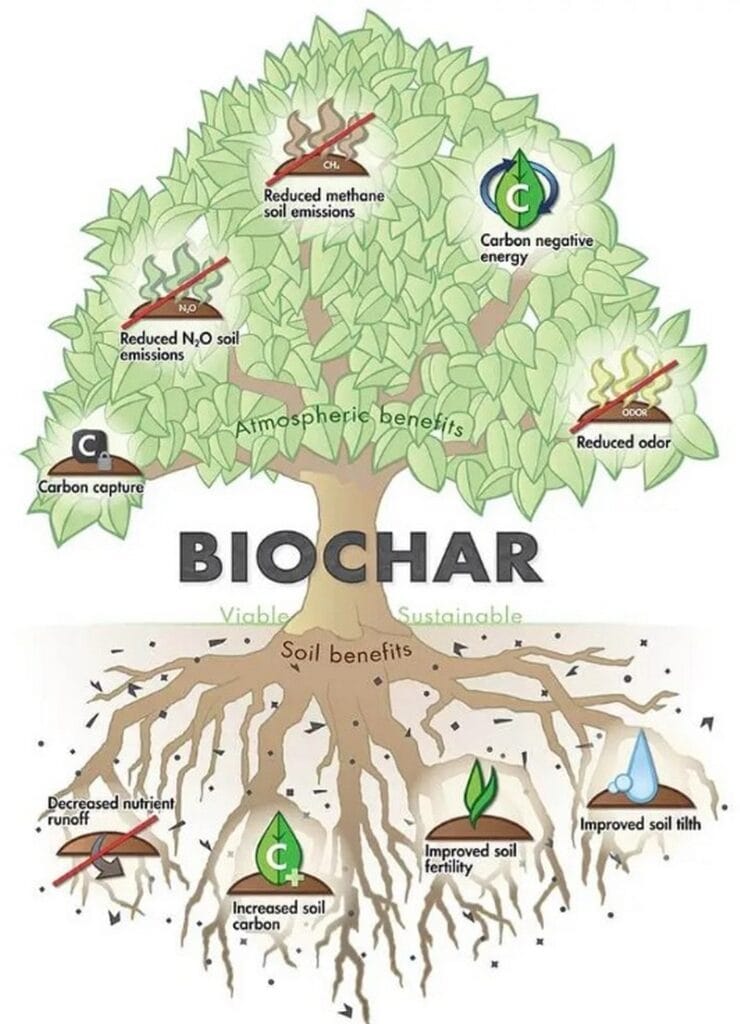
- Small biochar production systems with EU Green Program support
- Funding for shredders, bins and other collection equipment
- Legal obligations for public services to collect landscape residues
- Network of landscape residue management units in Greece and abroad (climate adaptation).
2. The What Happens if Municipalities Ignore Bio-Waste Rules?
Specific Penalties for Bio-waste Non-Compliance
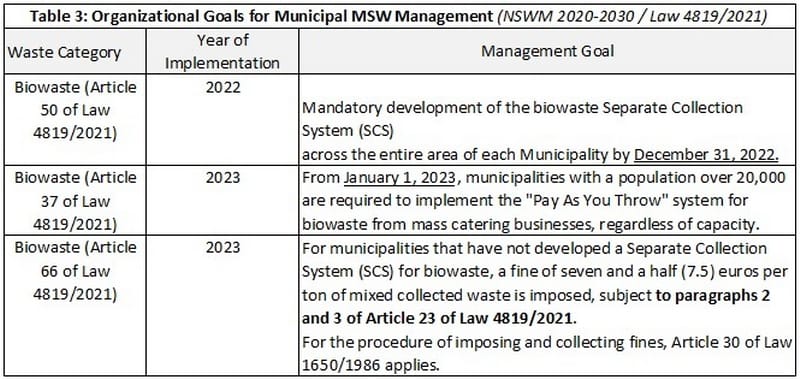
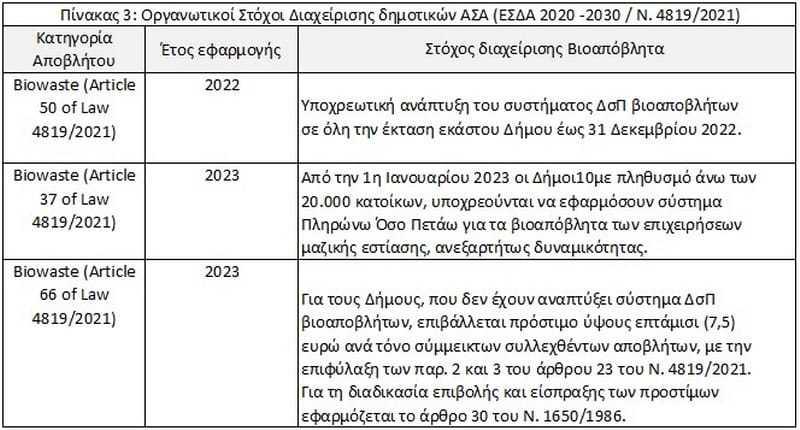
According to Article 66 of Law 4819/2021:
- Municipalities that have not developed separate collection systems for bio-waste will be fined €7.5 per ton of mixed collected waste
- This fine applies to municipalities that fail to implement the mandatory separate collection of bio-waste by the required deadline (December 31, 2022)
- The fine is imposed with the reservation of paragraphs 2 and 3 of Article 23 of Law 4819/2021
Enforcement Mechanism
https://www.chania.gr/files/55/46096/tosda_hanion.pdf
- For the procedure of imposing and collecting these fines, Article 30 of Law 1650/1986 applies
- This penalty system is part of the enforcement mechanism to ensure municipalities meet their legal obligations for separate bio-waste collection, which is a key component of Greece’s waste management strategy to achieve recycling and waste diversion targets.
3. Bio-waste Project Funding Details
Total Allocated Budget
The total budget for biowaste management is €3,463,258.00 (including VAT)
Funding Sources Breakdown
The funding for biowaste projects comes from multiple sources:
- €1,143,295.10 – From European Structural and Investment Funds:
- Operational Program “Crete 2014-2020”
- Operational Program “Transport Infrastructure, Environment and Sustainable Development 2014-2020”
- €291,453.10 – From Municipality’s own resources
- €203,112.00 – From
- “Smart Cities” program
- €1,825,397.80 – Listed as “Seeking funding” from sources such as:
- Public Investment Program
- ESPA 2021-2027
- Other potential sources
Implementation Timeline
Start date: 2022
Completion date: 2024
Based on this information (Pages 143-161)
https://www.chania.gr/files/55/46096/tosda_hanion.pdf
While funding sources have been identified, a significant portion (approximately €1.8 million) is still listed as “seeking funding,” suggesting that not all of the allocated budget has been secured or received.
The document doesn’t provide specific information about which portions of the already-identified funding (approximately €1.6 million) have actually been disbursed to the municipality.
Chapter 3: Summary of the Green Paper’s Key Points
Green Paper on Bio-Waste Management in the EU
Introduction
The European Commission’s Green Paper on the management of bio-waste (COM (2008) 811 final) addresses one of the EU’s most significant waste management challenges. Published in December 2008, this document explores options for improving bio-waste management across the European Union. The Green Paper aims to stimulate debate on potential policy actions, seeking stakeholder input on the most efficient and environmentally beneficial approaches to bio-waste management.
As the EU strives to become a resource-efficient “Recycling Society,” proper bio-waste management represents a critical opportunity to reduce environmental impacts while recovering valuable resources. The Green Paper serves as a foundation for potential future policy initiatives, inviting stakeholders to contribute their knowledge and perspectives on the way forward.
1. What is Bio-Waste and why it matters
Bio-waste is specifically defined as biodegradable garden and park waste, food and kitchen waste from households, restaurants, caterers and retail premises, and comparable waste from food processing plants.
Importantly, this definition excludes:
- Forestry or agricultural residues
- Manure
- Sewage sludge
- Other biodegradable waste (natural textiles, paper, processed wood)
- By-products of food production that never become waste
2. Management options (landfilling, composition, digestion, etc.)
The EU generates an estimated 76.5-102 million tonnes of bio-waste annually from municipal solid waste, plus up to 37 million tonnes from the food and drink industry. Bio-waste is typically wet and putrescible, with two major streams:
- Green waste from parks and gardens (50-60% water content, contains wood/lignocellulose)
- Kitchen waste (up to 80% water content, no wood)
Bio-Waste Management Methods
The Green Paper examines several management options for bio-waste:
Landfilling
- Currently the most used but least desirable option according to the waste hierarchy
- Produces methane (a potent greenhouse gas) and leachate that can contaminate groundwater
- Requires careful management under the EU Landfill Directive (impermeable barriers, methane capturing)
- Results in irrecoverable loss of resources and land
Incineration
- Bio-waste is typically incinerated as part of mixed municipal waste
- Can be classified as energy recovery or disposal depending on energy efficiency
- Incinerated bio-waste is considered carbon-neutral “renewable” fuel under EU directives
- Efficiency is reduced by the high moisture content of bio-waste
Biological Treatment
- Composting
- Most common biological treatment (95% of current operations)
- Best suited for green waste and woody material
- “Closed methods” are more expensive but faster and have better emissions control
- Home composting can be environmentally beneficial by eliminating transport emissions
- Anaerobic Digestion
- Especially suitable for wet bio-waste including fats (e.g., kitchen waste)
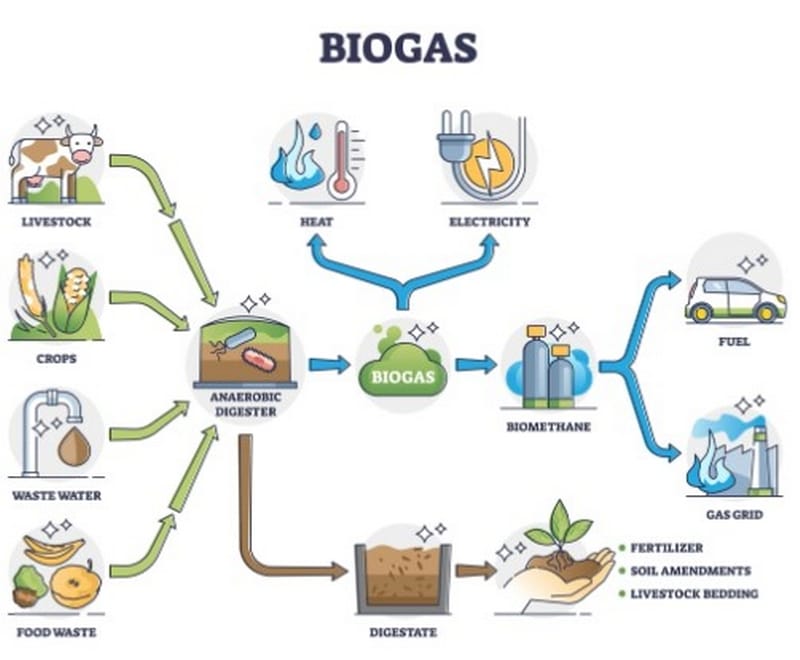
- Produces biogas (50-75% methane) in controlled reactors
- Biogas can significantly reduce greenhouse gas emissions when used as biofuel
- Digestate residue can be composted and used similarly to compost
- Mechanical-Biological Treatment (MBT)
- Combines biological treatment with mechanical treatment (sorting)
- Pre-treats mixed waste to produce more stable landfill input or improve combustion properties
- Can generate biogas when using anaerobic digestion, making it an energy recovery process
- Current State of Bio-Waste Management in EU Member States
The European Environment Agency identifies three main approaches to bio-waste management across the EU:
- Countries relying heavily on incineration with high material recovery rates and advanced biological treatment strategies: Denmark, Sweden, Belgium (Flanders), Netherlands, Luxembourg, France
- Countries with high material recovery but low incineration rates: Germany, Austria, Spain, Italy – some achieving the highest composting rates in the EU
- Countries primarily relying on landfills where diversion remains a major challenge due to lack of capacity: many new Member States
Candidate and potential candidate countries also rely mainly on landfilling.
On average, 41% of municipal solid waste is landfilled in the EU, though this percentage exceeds 90% in some Member States (e.g., Poland, Lithuania). However, the average amount of landfilled MSW has dropped from 288 to 213 kg/capita/year since 2000.
Separate collection of bio-waste has been successfully implemented in several Member States (Austria, Netherlands, Germany, Sweden, parts of Belgium, Spain, and Italy) . The overall potential for separately collected bio-waste is estimated at up to 150kg/inhabitant/year, but only about 30% of this potential is currently being realized.
3. Legal context and proposed policy improvements
EU Legal Framework for Bio-Waste
Several EU legal instruments address bio-waste management:
- Waste Framework Directive: Sets general waste management requirements and recycling targets
- Landfill Directive: Requires diversion of biodegradable municipal waste from landfills
- IPPC Directive: Covers permitting and control of bio-waste treatment installations above 50 tonnes/day capacity
- Waste Incineration Directive: Regulates incineration of bio-waste
- Animal By-products Regulation: Sets health rules for composting and biogas plants
- Renewable Energy Sources (RES) Directive: Contains measures on counting bio-wastes toward renewable energy targets.
For compost use, relevant regulations include:
- Organic Farming Regulation: Conditions for compost use in organic farming
- Eco-labels for soil improvers and growing media: Specify limits for contaminants
- Thematic Strategy for Soil Protection: Promotes compost as a source of stable organic matter for degraded soils
Environmental, Economic, and Social Considerations
Environmental Impacts
- Landfilling: Produces methane (23 times more powerful than CO2 for climate change) and leachate that can contaminate groundwater and soil
- Incineration: Environmental impact depends on energy efficiency, fuel quality, and the source of replaced energy
- Composting: Offers agronomic benefits including improved soil structure, water retention, and nutrient supply
- Anaerobic Digestion: Produces biogas that can significantly reduce greenhouse gas emissions when used as biofuel
The environmental balance between different management options depends on local factors including collection systems, waste composition, climatic conditions, and potential uses of waste-derived products. Life Cycle Assessment (LCA) studies show that benefits significantly depend on:
- Energy recovery efficiency
- Source of replaced energy
- Quality and use of recycled compost
- Emission profiles of biological treatment plants
Economic Impacts
Cost estimates for different bio-waste management options in the EU-15 (2002):
- Separate collection and composting: €35-75/tonne
- Separate collection and anaerobic digestion: €80-125/tonne
- Landfill of mixed waste: €55/tonne
- Incineration of mixed waste: €90/tonne
The additional costs of separate collection are estimated at €0-15/tonne, with potential for cost reduction through optimization of collection systems. Investment costs for biological treatment plants vary from €60-150/tonne for open composting to €350-500/tonne for closed composting and digestion in large-scale installations.
4. Recommendations and future directions
Market prices for compost vary widely based on public perception and customer confidence, ranging from symbolic prices (€1/tonne) for agricultural use to €14/tonne for recognized quality compost, and up to €150-300/tonne for small amounts of packed compost or blends.
Social and Health Impacts
Separate collection of bio-waste may create new jobs, being potentially three times more labor-intensive than collecting mixed waste. However, residents in areas with separate collection will need to change their waste separation habits.
Health impact studies show limited effects, with small risks of birth defects for families living near landfill sites and minor respiratory ailments for residents near composting plants, particularly open facilities.
Key Recommendations and Discussion Points
The Green Paper raises several key questions for stakeholder input:
- Waste Prevention: How to implement specific bio-waste prevention actions at the EU level
- Landfill Restrictions: Whether to further restrict biodegradable waste in landfills beyond existing Landfill Directive targets
- Treatment Options: Which options for diverted bio-waste should be strengthened and how life-cycle assessment can guide these decisions
- Energy Recovery: How energy recovery from bio-waste can contribute to sustainable resource management and renewable energy targets
- Recycling Promotion: Whether and how to promote bio-waste recycling through targets or separate collection obligations
- Quality Standards: Whether to set EU-wide quality standards for compost and digestate, and rules for their use
Operational Standards: Whether gaps exist in the regulatory framework for treatment plants below IPPC thresholds
Emerging Technologies: How to address advantages, disadvantages, and regulatory obstacles for new bio-waste management techniques
Conclusion
The Green Paper on bio-waste management represents an important step toward developing a comprehensive EU strategy for this significant waste stream. By examining current practices, regulatory frameworks, and potential improvements, the document lays the groundwork for more sustainable bio-waste management across the European Union.
The Commission invited stakeholder contributions until March 15, 2009, with the intention to present its analysis and potential proposals for an EU bio-waste management strategy later that year. This consultative approach underscores the EU’s commitment to evidence-based policy development that balances environmental, economic, and social considerations.